HOR-2026-001
Immigration and Crime in France:
A Consistent Link
Findings based on official data, 2010–2026
- Published
- 26 October 2026
- Licence
- CC BY 4.0
Abstract
Official French data for 2010–2026 show that foreign nationals are strongly over-represented in recorded crime. Foreign nationals are 9.1% of residents but 36% to 37% of suspects for burglary and theft from vehicles, about 20% of suspects for homicide and attempted homicide, 17% of people convicted and a quarter of prisoners. The gap has grown since 2016. Cities and départements with more immigrants record more violent theft and drug dealing; this link between places also reflects poverty and population density. Crime data record nationality only, so naturalised immigrants and the children of immigrants are counted as French and their involvement cannot be measured.
Keywordsimmigration, France, crime, foreign nationals, crime statistics
1Introduction
This paper sets out what French official data for 2010–2026 show about immigration and crime. It draws on police and gendarmerie records, court and prison statistics, the census and opinion polls.1 The national statistics office, INSEE, defines an immigrant as a person born abroad as a foreigner, whether or not they later became French: 7.97 million people (11.6% of the population) in 2025. A foreigner is anyone without French nationality: 6.30 million people (9.1%) (INSEE, 2026a). French crime statistics record nationality, not country of birth. Over-representation is measured by the ratio
where R = 1 means foreigners appear among suspects exactly in proportion to their numbers, and R = 4 means four times as often.
2Immigration and recorded crime, 2010–2025
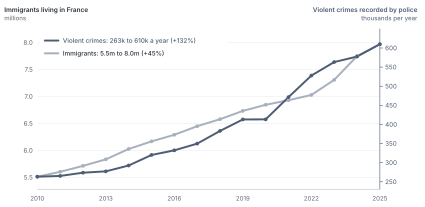
Between 2010 and 2025 the number of immigrants living in France rose from 5.51 to 7.97 million, an increase of 45% (INSEE, 2026a). In the same period the number of violent crimes recorded each year by the police and gendarmerie (murder, attempted murder, assault and sexual violence) rose from about 263,000 to 610,000, an increase of 132%. The figures for 2016–2025 come from the Interior Ministry’s statistical service (SSMSI, 2026b); those for 2010–2015 come from the older police series and were adjusted to match it in 2016 (Ministère de l’Intérieur, 2022).2
The correlation between the two series is 0.98 (Figure 1). A correlation coefficient shows how closely two sets of numbers move together. It runs from −1 to 1: at 0 there is no relation, and at 1 the two move in perfect step. Any two series that both rise steadily over fifteen years will be strongly correlated.
Most of the rise in recorded violence comes from violence within the family and sexual violence, which the SSMSI places in a context of victims speaking out more and being better received by the police (SSMSI, 2026e). Between 2016 and 2025 these two categories account for 80% of the increase (223,000 of 278,000). Violence outside the family rose by 32%, slightly faster than the immigrant population (27%), and recorded attempted murders nearly doubled, from 2,259 to 4,477 (SSMSI, 2026b). Between 2017 and 2025 the number of foreign suspects for violent crimes rose by 67% and the number of French suspects by 56% (SSMSI, 2026c).
3Foreign nationals in the crime statistics
3.1Suspects by offence
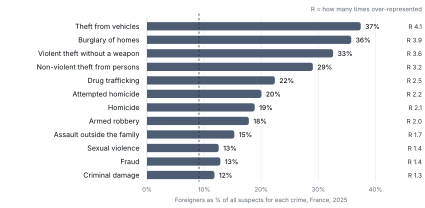
In 2025 foreign nationals made up 37% of suspects for theft from vehicles,3 36% for burglary, 33% for violent theft without a weapon, 29% for non-violent theft and 22% for drug trafficking. They were 9.1% of residents (Figure 2). For violent crime, they made up 20% of suspects for attempted homicide, 19% for homicide, 15% for assault outside the family and 13% for sexual violence (SSMSI, 2026a, 2026c). None of these categories includes immigration offences such as irregular stay, which only foreigners can commit. In a written answer to Parliament, the Interior Ministry put the foreign share of burglary suspects at 38% in 2024 (Assemblée nationale, 2025).
The gap has grown. Among theft suspects, the foreign share rose from 16.5% in 2008 to 26.8% in 2012, when foreigners were 6.1% of residents (Borredon, 2013; INSEE, 2026a). Between 2016 and 2025 it rose from 18% to 37% for theft from vehicles, from 26% to 36% for burglary, from 21% to 33% for violent theft, from 12% to 22% for drug trafficking and from 15% (2017) to 19% for homicide. The foreign share of residents rose from 6.8% to 9.1% over the same years (SSMSI, 2026c).
3.2Young men
Foreign residents are on average younger and more often male than French residents. If age and sex explained the gap, it would close when only young men are compared, but it remains. Table 1 sets the foreign share among all suspects against the foreign share among male suspects aged 18 to 29. In the 2023 census, foreign nationals were 8.1% of all residents and 9.5% of men aged 15 to 39 (INSEE, n.d.-c, n.d.-e).4 Among young men, foreigners are over-represented about 4 times for theft from vehicles, violent theft, non-violent theft and burglary, about twice for drug trafficking, homicide and attempted homicide, and 1.7 times for sexual violence.
Age and sex do not account for the over-representation. Depending on the offence, young foreign men are recorded as suspects 1.7 to 4.5 times as often as young men as a whole. Foreign nationals also account for a disproportionate part of the rise in violent-crime suspects. Between 2017 and 2025 the number of suspects for violent crimes rose by about 158,600; foreign nationals accounted for 26,200 of them, or 17%, about twice their share of the population (SSMSI, 2026c).
| Offence | Foreign share, all suspects | R, all | Foreign share, men 18–29 | R, men 18–29 |
|---|---|---|---|---|
| Theft from vehicles | 37.4% | 4.6 | 42.7% | 4.5 |
| Violent theft, no weapon | 32.6% | 4.0 | 40.3% | 4.2 |
| Non-violent theft from persons | 29.1% | 3.6 | 37.9% | 4.0 |
| Burglary of homes | 35.8% | 4.4 | 36.6% | 3.8 |
| Drug trafficking | 22.4% | 2.8 | 21.3% | 2.2 |
| Attempted homicide | 20.0% | 2.5 | 20.6% | 2.2 |
| Homicide | 18.9% | 2.3 | 19.2% | 2.0 |
| Armed robbery | 17.8% | 2.2 | 18.5% | 1.9 |
| Assault outside the family | 15.3% | 1.9 | 18.0% | 1.9 |
| Sexual violence | 12.6% | 1.6 | 16.0% | 1.7 |
R, all: foreign share of suspects divided by the foreign share of all residents (8.1%, census 2023). R, men 18–29: divided by the foreign share of men aged 15–39 (9.5%). The ratios in Figure 2 are lower because they use the 2025 estimate of the foreign population (9.1%). Sources: SSMSI (2026c); INSEE (n.d.-c, n.d.-e). Calculations by the authors.
3.3Convictions and prisons
Suspects are people the police record as involved in an offence; not all are prosecuted or convicted. Court and prison records show the same pattern at later stages. Foreign nationals made up 15% of people convicted in 2018 and 17% in 2023 (INSEE, 2025). They were 17.8% of prisoners on 1 January 2010 (Ministère de la Justice, 2010), 21% on 1 January 2020 (INSEE, 2021), 24.8% in 2025 and 24.0% on 1 May 2026, when 21,424 of 89,091 prisoners were foreign (Ministère de la Justice, 2026a, 2026b).
The Ministry of Justice publishes the shares of the five nationalities most represented in prison. Table 2 compares them with each nationality’s share of the population in the 2023 census (INSEE, n.d.-f). Algerian nationals are in prison at 6.8 times their share of the population, Romanians at 5.0 times, Tunisians at 4.5 times and Moroccans at 2.7 times. Portuguese nationals, the second-largest foreign group in France, are under-represented (0.7). The other foreign nationalities together are in prison at 2.5 times their share of the population, and French nationals at 0.8 times.5
| Nationality | Share of prisoners | Share of residents | Ratio |
|---|---|---|---|
| Algerian | 6.0% | 0.89% | 6.8 |
| Romanian | 1.1% | 0.22% | 5.0 |
| Tunisian | 1.7% | 0.37% | 4.5 |
| Moroccan | 2.1% | 0.79% | 2.7 |
| Portuguese | 0.6% | 0.81% | 0.7 |
| All other foreign nationalities | 12.5% | 5.01% | 2.5 |
| French | 76.0% | 91.91% | 0.8 |
The five nationalities are those the Ministry of Justice lists as the most represented in prison; it does not publish figures for others. Ratio: share of prisoners divided by share of residents. Sources: Ministère de la Justice (2026b); INSEE (n.d.-f). Calculations by the authors.
4Where the link is strongest
4.1Paris
In August 2022 the Interior Minister stated that foreigners accounted for 48% of arrests in Paris and 55% in Marseille; the Paris police headquarters confirmed the Paris figure (Agence France-Presse, 2024). In October 2022 the President said on France 2 that at least half of the crime recorded in Paris was committed by foreigners (as cited in Lamy, 2022). In February 2025 the Paris police chief put the foreign share of people suspected of crimes in his area at 36% (as cited in Assemblée nationale, 2025). Unaccompanied foreign minors made up 76% of all minors brought before the Paris prosecutor in 2020 and 11% of all suspects recorded in Paris in the first ten months of that year; 77% of those recorded in the Paris area said they were Moroccan or Algerian (Eliaou & Savignat, 2021).
4.2Cities with high immigrant population
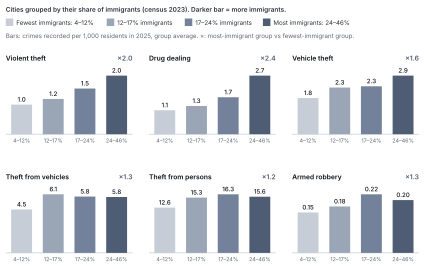
The 123 cities of mainland France with more than 50,000 inhabitants were matched with their immigrant share in the 2023 census (INSEE, n.d.-d) and their recorded crime in 2025 (SSMSI, 2026d).6 Cities with more immigrants have more crime. Sorted into four equal groups by immigrant share, the cities with the most immigrants have higher rates than those with the fewest for violent theft, drug dealing, vehicle theft, theft from vehicles, theft from persons and armed robbery (Figure 3). In the group where immigrants make up more than 24% of the population, the violent theft rate is twice that of the group where they make up less than 12.4% (2.0 against 1.0 per 1,000 inhabitants), and the drug trafficking rate is 2.4 times higher (2.7 against 1.1). Across all 123 cities, the immigrant share is correlated with drug trafficking (r = 0.49), violent theft (0.41) and the three crimes combined (0.40).
Six of the ten cities with the highest crime rate are in the top group for immigrant share. Their average immigrant share is 27%, against 17% for the typical city (Table 3). Five of the ten (Bondy, Saint-Ouen-sur-Seine, Bobigny, Saint-Denis and Pantin) are northern and north-eastern suburbs of Paris, in Seine-Saint-Denis. Seine-Saint-Denis is a département, one of the roughly 100 administrative areas into which France is divided, similar in size to a county. With immigrants making up 31% of its population, it has the highest immigrant share of any département in mainland France (INSEE, n.d.-a). Vénissieux, third, is a suburb of Lyon. Bondy, Bobigny and Saint-Denis, where immigrants make up 34% to 39% of the population, rank first, fourth and sixth for crime among the 123 cities.
| Rank | City | Immigrants, % of population | Crime rate, per 1,000 residents |
|---|---|---|---|
| 1 | Bondy (Paris suburb) | 34.1 | 18.9 |
| 2 | Saint-Ouen-sur-Seine (Paris suburb) | 29.8 | 15.6 |
| 3 | Vénissieux (Lyon suburb) | 28.4 | 15.1 |
| 4 | Bobigny (Paris suburb) | 38.7 | 15.0 |
| 5 | Perpignan | 18.0 | 13.4 |
| 6 | Saint-Denis (Paris suburb) | 38.5 | 13.3 |
| 7 | Pantin (Paris suburb) | 30.6 | 13.0 |
| 8 | Lille | 14.8 | 12.9 |
| 9 | Grenoble | 19.6 | 12.8 |
| 10 | Rouen | 14.7 | 12.7 |
| All 123 cities, median | 16.6 | 7.4 | |
Crime rate: violent thefts, assaults outside the family and drug-trafficking suspects recorded in 2025, per 1,000 residents. Paris suburbs are in Seine-Saint-Denis. Sources: SSMSI (2026d); INSEE (n.d.-d). Calculations by the authors.
4.3Poverty and population density
Places with many immigrants also tend to be poorer and more densely populated, and both are linked to crime. Across the 96 départements of mainland France, the immigrant share is correlated with population density (r = 0.79, on a logarithmic scale) and with the poverty rate (0.42). City-level income data were not available, so this check uses départements. Once poverty and density are taken into account, the link with the immigrant share falls for every offence and remains positive only for drug trafficking (SSMSI, 2026b; INSEE, n.d.-a, n.d.-b).
This result concerns places, not people. It does not change the over-representation of foreign nationals among suspects, convicted persons and prisoners shown in Section 3, which compares individuals.
5French citizens of immigrant origin
All the figures above concern foreign nationals. Naturalised immigrants, about 2.6 million people in 2025 (INSEE, 2026a), and French-born children of immigrants are recorded as French. French statistics do not record the origin of suspects or prisoners. In 2022 the Interior Ministry stated that it holds no statistics on dual nationality (as cited in Sénat, 2026), and a 2022 parliamentary question asking for the number of dual-national prisoners by second nationality lapsed without an answer (Assemblée nationale, 2024). No official French source measures the offending of naturalised immigrants or of the children of immigrants.
Of the people arrested during the riots of June–July 2023, 71% were French nationals, according to the Senate inquiry (Barbarit, 2024). In Denmark, where origin is recorded, men of non-Western origin (immigrants and their children) were convicted of criminal offences in 2023 at 2.6 times the rate expected for their age (Justitsministeriet, 2025). No comparable figure exists for France. The foreign-national figures are therefore a lower bound on the involvement of people of immigrant origin; how much higher the true figure is cannot be established from French data.
6The protests of October 2026
On 17 October 2026 protests against the cost of living took place across France, with about 550,000 participants according to the Interior Ministry (Europe 1, 2026). Many ended in rioting and looting; in Limoges the city hall was set on fire (Gutkind, 2026). The Interior Ministry reported 2,397 arrests and 997 police officers and gendarmes injured, seven of them seriously (CNews, 2026). A second day of protests, on 24 October, drew 410,000 people and led to nearly 1,000 arrests (Europe 1, 2026).
The Interior Minister attributed the violence to several thousand ultra-left activists, joined by looters (Gutkind, 2026). The Justice Minister, Gérald Darmanin, described the defendants tried in Marseille as socially mixed: some known to the police, some in work, some from deprived neighbourhoods and the suburbs of Paris and Lyon, others linked to the ultra-left (Mesinfos, 2026). As of 26 October 2026, no official figures on the nationality or origin of the people arrested had been published.
7What the French think
Most recent polls find that a majority of the French see a link between immigration and insecurity (Table 4). In the CSA polls for CNews, Europe 1 and the JDD, the share who say such a link exists rose from 68% in May 2024 to 72% in September 2025. In November 2025, 56% said immigration plays a major role in rising insecurity and 13% said it plays none. After the riots of 17 October 2026, 55% saw a link between the violence and immigration. Worry about immigration and feeling unsafe go together. In January 2024, 57% of the French who were worried about immigration scored high on a scale of personal insecurity, against 25% of those who were not (CEVIPOF, 2024).
| Year | Poll | Statement | Agree |
|---|---|---|---|
| 2014 | Pew | Immigrants are more to blame for crime than other groups | 36% |
| 2018 | Pew | Same question | 22% |
| 2020 | CNCDH | Immigration is the main cause of insecurity | 52% |
| 2024 | CNCDH | Same question | 46% |
| 2025 | CNCDH | Same question | 44% |
| May 2024 | CSA | There is a link in France between insecurity and immigration | 68% |
| Sep 2025 | CSA | Same question | 72% |
| Nov 2025 | CSA | Immigration plays a major role in rising insecurity | 56% |
| Oct 2026 | CSA | There is a link between immigration and the violence of 17 October | 55% |
Statements paraphrased from the published reports; the questions differ, so the series cannot be compared directly. Sources: Pew Research Center (2019); Philippe & Valette (2023) for CNCDH 2020; CNCDH (2025, 2026); Europe 1 (2024, 2025); CNews (2025); Pascolo (2026). CSA samples about 1,000 adults, online.
8Limitations
Nationality only. French crime, court and prison data record nationality, not country of birth or parents’ origin. Naturalised immigrants and the children of immigrants are counted as French, so their involvement cannot be measured.
Suspects, not offenders. Most figures count people recorded by the police as suspects in solved cases. Who is recorded depends in part on where and whom the police check, and police checks are not random. A person suspected of several offences may appear in more than one category. The conviction and prison figures in Section 3.3 support the same conclusion, but they are not broken down by offence here.
Recorded crime is not all crime. Many offences are never reported. Part of the rise in recorded violence since 2016 reflects more reporting of family and sexual violence (SSMSI, 2026e). The 2010–2015 figures come from an older series, joined to the current one in 2016, and INSEE’s 2024–2025 immigration figures are provisional.
Places, not people. The city and département comparisons in Section 4 show that crime is higher where more immigrants live, but this also reflects poverty and density. Crime is counted where it occurs, not where the suspect lives, which raises rates in city centres.
Polls. The polls in Table 4 ask different questions, and their results depend on the wording.
9Conclusion
Official French data for 2010–2026 show a consistent pattern. Foreign nationals were over-represented among suspects: about 4 times for burglary and theft, and 2 to 2.5 times for homicide and attempted homicide. The gap grew after 2016 and is not explained by age or sex. Foreign nationals make up 17% of people convicted and about a quarter of prisoners, and Algerian, Romanian and Tunisian nationals are in prison at 4.5 to 7 times their share of the population. The gap is largest in Paris. Cities and départements with more immigrants record more violent theft and drug dealing; this link between places also reflects poverty and population density. Because French statistics record nationality only, the involvement of naturalised immigrants and of the children of immigrants cannot be measured; it is probably larger than the foreign-national figures show, but by how much is unknown. A majority of the French see a link between immigration and insecurity.
Notes
- Crime data: SSMSI open data on suspects (2016–2025) and the communal and départemental crime bases (2016–2025); the older police series “état 4001” (1996–2022). Census data: INSEE Melodi API. All retrieved from data.gouv.fr and insee.fr. French and Danish sources are translated by the authors.↩
- 2016–2025: SSMSI count of recorded victims of homicide, attempted homicide, physical violence within and outside the family, and sexual violence. 2010–2015: the same offence categories in the older police series (état 4001, indices 1–7, 46–49, 51 and 52), multiplied by 1.05 so that both series match in 2016. Over 2016–2021, when both exist, they grew by 47% and 42%.↩
- Figures of about 40% for “car thefts” cited in the public debate in 2024–2025 refer to thefts from vehicles.↩
- The SSMSI groups suspects aged 18–29; the census groups residents aged 15–24 (foreign share among men 7.1%) and 25–39 (11.2%). The table uses men aged 15–39 (9.5%). Using the higher figure of 11.2%, R for young men is still 3.3 to 3.8 for theft and burglary and 1.7 to 1.8 for homicide and attempted homicide.↩
- Prison figures include some people who do not live in France and are therefore not in the census, which raises the ratios. The foreign population grew between 2023 and 2026, which has the same effect.↩
- Communes with more than 50,000 inhabitants in mainland France (excluding overseas territories). Paris, Lyon and Marseille are counted as whole cities. Rates are per 1,000 residents. Spearman rank correlations: drug trafficking 0.44, violent theft 0.45, three crimes combined 0.34.↩
References
- Agence France-Presse. (2024, May 6). Immigration et délinquance : attention aux interprétations trompeuses des chiffres du ministère de l’Intérieur [J. Zablit]. AFP Factuel.
- Assemblée nationale. (2024). Question écrite n° 2168 (A. Loubet) : détenus étrangers et binationaux [Publiée le 11 octobre 2022, retirée le 11 juin 2024].
- Assemblée nationale. (2025). Question écrite n° 5430 (M. Guiniot) : part des étrangers parmi les mis en cause [Publiée le 25 mars 2025; réponse du ministère de l’Intérieur publiée le 17 juin 2025].
- Barbarit, S. (2024, April 11). Violences urbaines : quel est le profil des émeutiers ? Public Sénat.
- Borredon, L. (2013, December 16). La part des étrangers mis en cause pour vols a fortement augmenté depuis 2008. Le Monde.
- CEVIPOF. (2024). La cité de la peur : l’insécurité et le choix politique (Baromètre de la confiance politique, vague 15). Sciences Po.
- CNCDH. (2025). Les essentiels du rapport 2024 sur la lutte contre le racisme, l’antisémitisme et la xénophobie. Commission nationale consultative des droits de l’homme.
- CNCDH. (2026, June 25). Rapport 2025 sur la lutte contre le racisme, l’antisémitisme et la xénophobie [Communiqué de presse].
- CNews. (2025, November 12). Sondage : pour 56 % des Français, l’immigration joue un rôle majeur dans l’augmentation de l’insécurité en France [CSA for CNews, Europe 1 and JDD, 7–10 November 2025, n = 1,011].
- CNews. (2026, October 18). Mobilisation du 17 octobre : 2.397 personnes ont été interpellées et 997 policiers et gendarmes ont été blessés, dont 7 grièvement [Live report].
- Eliaou, J.-F., & Savignat, A. (2021). Rapport d’information sur les problématiques de sécurité associées à la présence de mineurs non accompagnés (No. 3974). Assemblée nationale, Commission des lois.
- Europe 1. (2024, June 2). Sondage : 68 % des Français estiment qu’il existe un lien en France entre insécurité et immigration [CSA for Europe 1, CNews and JDD, 30–31 May 2024, n = 1,011].
- Europe 1. (2025, September 6). Sondage : 72 % des Français estiment qu’il existe un lien entre insécurité et immigration [CSA for Europe 1, CNews and JDD, 4–5 September 2025, n = 1,011].
- Europe 1. (2026, October 24). En direct : manifestations du 24 octobre, Laurent Nuñez annonce « près de 1.000 interpellations » sur tout le territoire.
- Gutkind, R. (2026, October 18). France : violences, le gouvernement pointe la responsabilité de l’ultragauche. Euronews (with AFP).
- INSEE. (2021). Auteurs selon la nationalité. In Sécurité et société (Insee Références, pp. 144–145).
- INSEE. (2025). Justice. In France, portrait social (Insee Références, édition 2025). https://www.insee.fr/fr/statistiques/8612554
- INSEE. (2026a). L’essentiel sur… les immigrés et les étrangers (updated June 25, 2026). https://www.insee.fr/fr/statistiques/3633212
- INSEE. (n.d.-a). Population immigrée selon les principaux pays de naissance en 2022 : comparaisons départementales. https://www.insee.fr/fr/statistiques/2012727
- INSEE. (n.d.-b). Taux de pauvreté par tranches d’âges en 2023 : comparaisons départementales. https://www.insee.fr/fr/statistiques/2012803
- INSEE. (n.d.-c). Population détaillée par sexe, âge et nationalité (NAT1), recensement 2023 [Data set DS_RP_TD_NAT_AGESEX_PRINC]. Melodi API.
- INSEE. (n.d.-d). Population détaillée par sexe, âge et situation quant à l’immigration (IMG1), recensement 2023 [Data set DS_RP_TD_IMMI_AGESEXEMPSTA_PRINC, communes]. Melodi API.
- INSEE. (n.d.-e). Migrations résidentielles selon l’âge et la nationalité (MIG1), recensement 2023 [Data set DS_RP_TD_MIGRES_PRINC]. Melodi API.
- INSEE. (n.d.-f). Population par sexe, âge et nationalité actuelle (13 regroupements), recensement 2023 [Data set DS_RP_TD_NAT_AGESEX_NATIONALITY_R_PRINC]. Melodi API.
- Justitsministeriet. (2025). Kriminalitet og herkomst 2023. Danish Ministry of Justice.
- Lamy, G. (2022, November 10). [Report of E. Macron’s interview in L’Événement, France 2, 26 October 2022]. Lyon Capitale.
- Mesinfos. (2026, October 21). Violences du 17 octobre : Gérald Darmanin dresse le portrait-robot des personnes jugées.
- Ministère de l’Intérieur. (2022). Chiffres départementaux mensuels relatifs aux crimes et délits enregistrés par les services de police et de gendarmerie depuis janvier 1996 [Data set, état 4001]. data.gouv.fr.
- Ministère de la Justice. (2010). Réponse à la question écrite n° 85954 [Assemblée nationale, réponse publiée le 19 octobre 2010].
- Ministère de la Justice. (2026a). Réponse à la question écrite n° 12283 [Assemblée nationale, réponse publiée le 26 mai 2026].
- Ministère de la Justice. (2026b). Réponse à la question écrite n° 11522 [Assemblée nationale, réponse publiée le 30 juin 2026].
- Pascolo, U. (2026, October 22). Sondage : violences du 17 octobre, 55 % des Français estiment qu’il existe un lien avec l’immigration [CSA for Europe 1, CNews and JDD, 20–21 October 2026, n = 1,011]. Europe 1.
- Pew Research Center. (2019). Global attitudes towards immigrants: Topline [Spring 2014 and Spring 2018 surveys].
- Philippe, A., & Valette, J. (2023). Immigration et délinquance : réalités et perceptions (La Lettre du CEPII, No. 436). CEPII.
- Sénat. (2026). Question écrite n° 07264 (V. Boyer) : binationaux franco-algériens [Publiée au Journal officiel le 15 janvier 2026].
- SSMSI. (2026a). Insécurité et délinquance en 2025 : une première photographie [Communiqué de presse, 29 janvier 2026]. Ministère de l’Intérieur.
- SSMSI. (2026b). Bases statistiques communale, départementale et régionale de la délinquance enregistrée par la police et la gendarmerie nationales, base départementale [Data set, produced June 25, 2026]. data.gouv.fr.
- SSMSI. (2026c). Principales caractéristiques des victimes enregistrées et des mis en cause pour des infractions élucidées par la police et la gendarmerie nationales [Data set, January 29, 2026]. data.gouv.fr.
- SSMSI. (2026d). Bases statistiques communale, départementale et régionale de la délinquance enregistrée par la police et la gendarmerie nationales, base communale [Data set, produced June 25, 2026]. data.gouv.fr.
- SSMSI. (2026e). Victimes de violences physiques et sexuelles enregistrées en hausse en 2025 [Communiqué de presse, 27 février 2026]. Ministère de l’Intérieur.
How to cite
Briatka, S., & Girard, M. (2026). Immigration and crime in France: A consistent link. Findings based on official data, 2010–2026 (HOR-2026-001). Hegemonium Open Research. https://research.hegemonium.com/papers/hor-2026-001/
Licence
© 2026 Simon Briatka and Maurice Girard. Published by Hegemonium Open Research under the Creative Commons Attribution 4.0 International licence (CC BY 4.0): you may share and adapt this work for any purpose, provided you credit the authors.